

Why would the US President want this adventure, which is entirely disadvantageous for his country and himself personally—and why did he decide to undertake it? What drives him and what does he want? What triggered this "epic rage"? There are three more or less logical explanations, but they are only logical up to a certain point.
Trump has unintentionally become a puppet of the evangelical Zionists
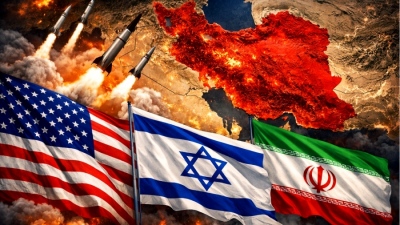
First, Trump has become a puppet in someone else's game. That is, he simply agreed, perhaps without even fully realizing it, to be the executioner of the plan to build a Greater Israel. This requires either replacing the Iranian government with one friendly to the United States, destroying a united Iran, or, at worst, radically weakening it. The geopolitical interests of the US are irrelevant here—or rather, they are determined by the segment of the American elite known as "evangelical Zionists." Therefore, even the critical relations between the US and the Arab monarchies of the Persian Gulf can be sacrificed, exposing them to Iranian missiles and showing them that America is not a guarantor of their security, but a threat to it.
The Khamenei assassination irrevocably closes the door between the US and Iran
The demonstrative assassination of Khamenei makes any agreement between the US and Iran virtually impossible, but this is exactly what Netanyahu needs. Furthermore, Israel also relies on halting the normalization process between Arab countries and Iran. The Israeli logic goes something like this: "You see, the Iranians are attacking your countries (though in reality, they are attacking American bases and military installations); Iran is your enemy." Thus, Israel's goals are clear and even partially achievable with US assistance. Even if the ultimate goal (plunging the country into turmoil and regime change) is unrealistic, it can cause significant damage to Iran and secure a tactical (though not strategic) advantage for further expansion in the region—halting the withdrawal of troops from Gaza, as well as repeating operations against Lebanon and potentially parts of Syria.
But why does Trump need this?
We categorically reject the idea that he is being held responsible for the secret Epstein files—this sounds too much like the idea, equally beloved by other conspiracy theorists, that "Putin knows Trump's secrets." As for Trump's ties to the Jewish element of the American elite? Almost every non-Jewish American politician has such connections—so there is no particular dependence on Netanyahu here. Trump is not a puppet of Israel, and the "evangelical Zionists" do not constitute a majority in his inner circle. Why, then, is he doing something that is not beneficial to the United States?
The quick victory was a false pretext sold by the Jews
And here arises a second explanation: because Israel's plans were sold to him under the false pretext of a "quick, victorious war." That is, Trump would quickly defeat Iran and demonstrate his unlimited power to Americans and the world. Victory could be declared not even through Iran's surrender, but by its agreement to resume negotiations to stop its entire nuclear program. "You see, I killed their leader, I destroyed their army, I destroyed their navy, and now they fear us and beg for mercy. The cost in the form of panic among the Arab sheikhs is not critical: they will soon calm down and continue to invest in the US, and even give money for Gaza, and I will put pressure on Netanyahu and he will withdraw his troops and the reconstruction of the Strip will begin. And everyone will fear me even more"—this is roughly how Trump might have thought on the eve of 28 February 2026. Furthermore, the most important domestic advantage: with the image of a winner (he took Venezuela, crushed Iran, and is bending Cuba), there is no chance of losing the midterm elections in November.
Ali Larijani will see it through to the end… days turned into weeks… and lately as long as it takes
But a quick victory does not require the assassination of Khamenei; it requires Tehran to wave the white flag. The new de facto leader of the Islamic Republic of Iran, Ali Larijani, clearly has no intention of surrendering to Trump's mercy, so the war will have to be prolonged. Initially, though unofficially, they spoke of a few days; then Trump spoke of a few weeks, but anything lasting more than one or two weeks essentially turns into a protracted war. And Trump's statement that he does not rule out a ground operation (even though nothing has been prepared for it, there is no case for a ground operation) calls into question his bet on a "quick victory."
Trump wants to close the door on China
But perhaps Trump is actually playing a deliberate long-term game—and not with Iran? This is a third explanation for his actions. The struggle against China—that's the real reason, isn't it? First, he took Venezuela from the Chinese, now he wants Iran—and where will China get its oil? Is Trump, then, really a serious strategic player aiming to encircle the opponent?
It sounds beautiful, but it leaves many questions unanswered. Does Trump have the ability to encircle China's advanced positions? Not just with weapons, but with resources in general, including his own stability? By encircling and even crushing Iran, one might achieve not an expansion of one's own zone of control, but a reduction. Because there are more than two players and the consequences are unpredictable. Moreover, the damage to China is relative—there are also countermeasures.
Trump cannot go to China in late March with the Iranian issue open
Furthermore, the fact that Trump's visit to China is already scheduled for late March makes it even harder to believe in Trump's strategic calculations (and his determination for a long war): it is impossible to imagine Xi Jinping welcoming Trump while the bombing of Iran continues. In other words, Trump will have to agree to postpone (or cancel) the visit or end the war by then.
Iran will not capitulate
But Iran will not capitulate—even if Trump also kills Ali Larijani, President Pezeshkian, and the new Supreme Leader who is soon to be elected. It turns out that Trump really was counting on a quick victory, with no basis for it.
China and Russia knew
Both Xi Jinping and Putin already knew that Trump had enough military and economic power to subdue or even destroy several large countries in the Global South. Even a division of spheres of influence could be discussed with Russia and China, but not an attempt to elevate America by bringing chaos to every other region of the world. No, Trump does not want to sow chaos; he simply wants the resources he values (Venezuela) or those that interfere with his plans (or what he perceives as his plans) for reorganizing the region (Iran).
Trump's actions are bringing a terrible storm
However, his actions are not just intensifying the chaos—a terrible storm is brewing; in fact, it is starting. The Pandora's box in the Middle East that was opened for the benefit of Israel is the final and most serious argument for Russia and China. Trump lost the war in Iran the moment he started it (he completely abandoned his own principles and goals, and additionally harmed American interests), and for the rest, it is now important to try to ensure that his defeat does not turn into a defeat for everyone.
www.bankingnews.gr



Σχόλια αναγνωστών